


By: Author: Neethi Zenith, Senior Legal Consultant, Al Adly & Co
The UAE family law 2025 reform is one of the most significant updates to UAE family law in recent years and matters directly to spouses, parents and internationally mobile families. Since 15 April 2025, the UAE's new Personal Status Law, issued under Federal Decree-Law No. 41 of 2024, has substantially updated the long-standing framework of Federal Law No. 28 of 2005, covering marriage, divorce, child custody, guardianship, maintenance and international child travel. For the first time, the new law also introduces a dedicated civil-style framework for non-Muslim expatriates who elect to apply it.
If you already have a custody order, a maintenance arrangement, a pending divorce case, or an international child travel issue in the UAE, the reform may directly affect your legal position. In some cases, arrangements that were previously regarded as settled may now be open to review- especially where custody, international travel or financial support is concerned.
This article explains the main changes in practical terms, compares the position under the 2005 and 2024 laws, and sets out what families, expatriates and employers should consider next. It is written for clarity before taking action, not as a substitute for tailored legal advice.
Seek out our family lawyers if you need individual legal advice.
Key Takeaways

The UAE family law 2025 reform places stronger emphasis on the child's best interests, extends age-based custody thresholds, introduces clearer rules on international travel, and creates a dedicated civil-style framework for non-Muslim expatriates. Courts may now look more closely at family facts, financial evidence, the child's welfare and the practical effect of any proposed arrangement.
Area | What Parents, Spouses and Expatriates Should Know |
|---|---|
Divorce | Attendance before the Family Guidance Committee is generally a mandatory step before divorce proceedings can be initiated on the federal personal status track. |
Custody | Default age-based transfer of custody has been substantially extended; the mother may now retain custody until the child reaches adulthood (age 18), subject to the court's assessment of the child's best interests. |
Child travel | Clearer framework for exit permits, strengthened anti-relocation provisions, and expedited court processes for urgent international travel disputes (e.g., where a parent fears imminent unauthorised removal of a child). |
Maintenance | Courts must consider the standard of living during marriage, the parties' financial positions, and the child's needs including education, healthcare and reasonable extracurricular costs. |
Non-Muslim families | Non-Muslim expatriates may elect to apply a civil-style framework with more equal custody treatment and greater flexibility on divorce and financial distribution. |
DIFC / ADGM | The DIFC and ADGM Family Courts continue to operate under their own civil/common-law frameworks. The interaction with the federal law is a developing area. |
Important – DIFC/ADGM: Federal Decree-Law No. 41 of 2024 does not automatically override DIFC or ADGM family law frameworks. Jurisdiction depends on domicile, habitual residence, and court rules – obtain specific advice.
What Is the UAE Personal Status Law 2025?

The new Personal Status Law updates major parts of the previous family-law framework under Federal Law No. 28 of 2005. The official text of Federal Decree-Law No. 41 of 2024 covers marriage, divorce, custody, guardianship, maintenance and related court procedures.
For most families, the practical question is not only what the law says. The more urgent question is whether the reform changes their immediate legal position. It may do so if a parent wants to review an existing custody order, seek a revised maintenance amount, request travel permission, respond to a divorce filing, or – for non-Muslim expatriates – elect the new civil-style framework.
Who Does Federal Decree-Law No. 41 of 2024 Apply To?

Federal Decree-Law No. 41 of 2024 applies across the UAE, but its practical reach varies depending on nationality, religion and, in some cases, the emirate or free zone where proceedings take place.
Family Situation | Practical Relevance |
|---|---|
Muslim UAE nationals | Fully governed by the new law. All provisions relating to marriage, divorce, custody, maintenance and guardianship apply by default. |
Muslim expatriates | The UAE Personal Status Law may apply, subject to the facts and any relevant conflict-of-law issue. |
Non-Muslim residents | Civil personal status rules may also be relevant. The UAE Government explains that Federal Decree-Law No. 41 of 2022 gives non-Muslim residents certain civil personal status options. |
Families with DIFC, ADGM or foreign-law links | Forum and applicable law should be checked before proceedings begin. Residence, court rules and agreements may matter. |
Non-Muslim families should not assume that one statute answers every question. In practice, the Civil Personal Status Law, Abu Dhabi rules, Dubai procedures and foreign-law connections may all affect the best procedural route.
Divorce in the UAE: What Changes in Practice?

Divorce proceedings in the UAE can still involve reconciliation or family-guidance steps. The new law also introduces clearer guidelines on cooling-off periods between initial filing and final divorce decree. Professional commentary on the reform, including this overview of changes under the new Personal Status Law, notes that the role of family guidance should be understood carefully under the new law rather than described as a blanket requirement in every case.
If reconciliation before the Family Guidance Committee is unsuccessful, the committee issues a certificate that permits the parties to proceed to court. This is an additional procedural step that affects timelines.
For spouses, preparation matters. You should understand which court may hear the case, what documents are needed, whether children are involved, and whether maintenance, housing, travel or assets are likely to be disputed.
Child Custody and Guardianship: The Welfare of the Child Comes First

The UAE family law 2025 reform is particularly important for parents because custody and guardianship often affect daily life more than any other issue. Custody concerns the child's day-to-day care. Guardianship usually relates to broader decisions such as education, travel, health, documents and legal representation.
Under the previous law (Federal Law No. 28 of 2005), custody typically transferred to the father when a boy reached 11 years and a girl reached 13 years. That age-based transfer has now been substantially extended. The mother may now retain custody until the child reaches adulthood (age 18), subject to the court's assessment of the child's best interests.
The new framework should be approached through the child's welfare. A court may consider the child's stability, school life, health, relationship with each parent, living arrangements and the ability of each parent to meet the child's needs.
Question | Why It Matters |
|---|---|
Where does the child currently live? | Stability and routine can be important in a custody dispute. |
Who manages school, health and daily care? | Practical care is often more persuasive than general statements. |
Is either parent planning to relocate? | Relocation can affect contact, schooling and travel arrangements. |
Is the child old enough to express a view? | Older children may have greater input, but their preference does not replace the court's assessment. |
Are passport or travel issues disputed? | These issues should be documented before travel plans are made. |

International families in Dubai, Abu Dhabi and other Emirates often face difficult questions about child travel. A parent may want to take the child abroad for holidays, medical care, school visits or a permanent move. Under the UAE family law 2025 framework, travel and relocation should be handled carefully and documented in writing.
Before any international trip, parents should clarify the destination, travel dates, return date, passport arrangements, contact during the trip and any court order or written consent required. Where the parents disagree, a court application may be needed before travel takes place. This includes expedited court processes for urgent applications – for example, where a parent fears imminent unauthorised removal of a child.
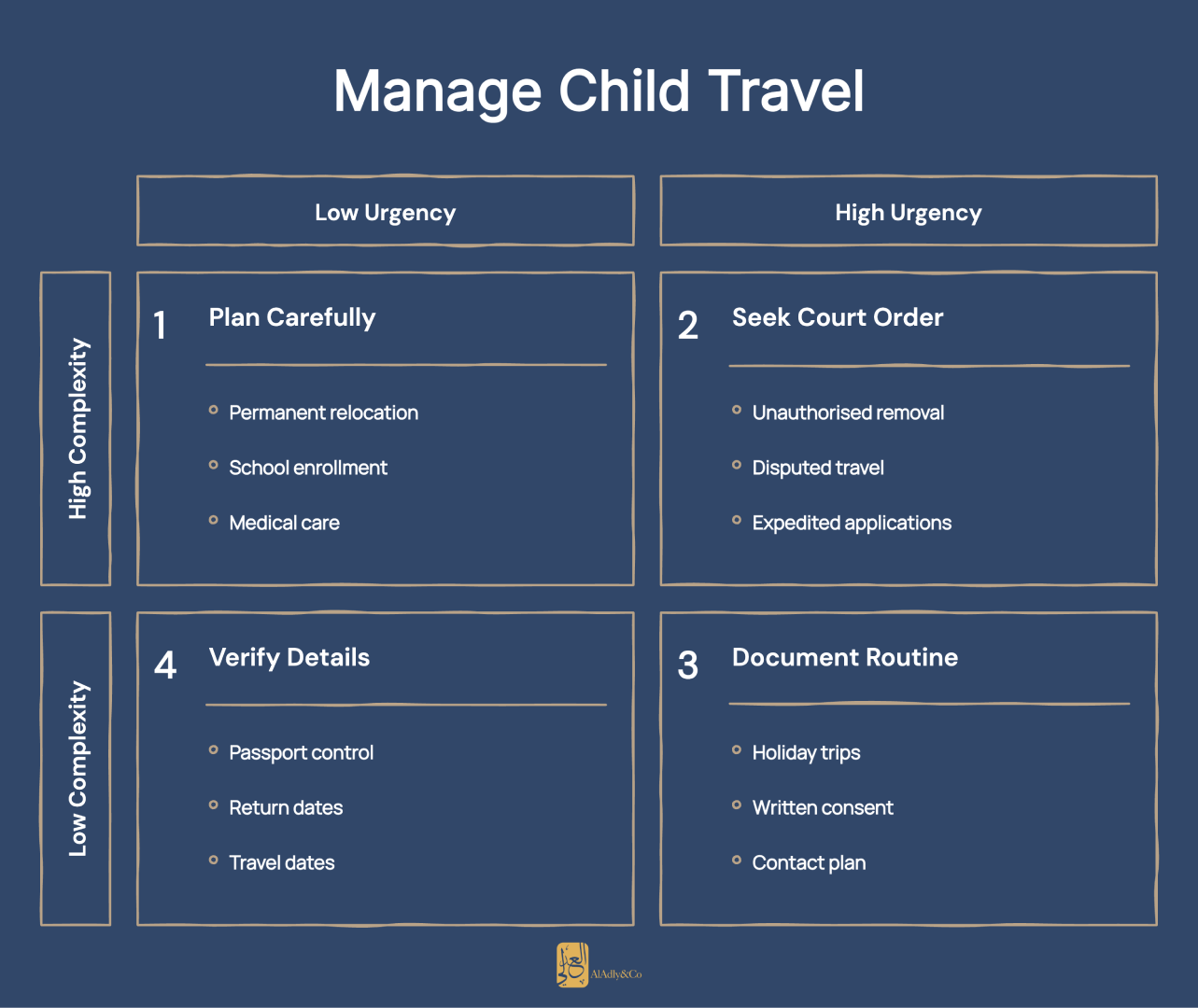
If relocation is proposed, the court is likely to examine the effect on the child's welfare and the child's relationship with both parents. A parent who wants to move should be ready to show why the move is in the child's interests and how meaningful contact with the other parent will continue.
Child Maintenance and Financial Support

The UAE Personal Status Law 2025 also matters for maintenance. Courts may consider income, housing costs, school fees, medical expenses, the child's needs and the family's standard of living. The stronger your evidence, the easier it is to present a clear position.
Existing maintenance agreements or court orders remain important. They do not become irrelevant simply because the law has changed. However, a review may be appropriate if income, living costs, school fees, health needs or the care arrangement has changed materially.
Voluntary maintenance agreements: Voluntary maintenance agreements made before 15 April 2025 remain valid. However, the new law may affect how they are interpreted, enforced, or reviewed upon application.
Document | Why It Helps |
|---|---|
Salary certificates and income records | They show financial capacity. |
Bank statements | They help evidence recurring expenses and payments. |
Tenancy contracts or property records | Housing costs are often central to maintenance. |
School and medical invoices | They support the child's specific needs. |
Existing agreements or court orders | They show the baseline from which any change is requested. |
Non-Muslim Families: Why Applicable Law Must Be Checked Carefully

For non-Muslim expatriates, the legal picture can be more layered. It is not safe to answer every question only by reference to the UAE family law 2025 reform. Civil personal status rules, local practice in the relevant Emirate, the parties' nationality, foreign marriage documents and existing agreements may all matter.
The UAE Government guidance on civil personal status rules for non-Muslims explains that Federal Decree-Law No. 41 of 2022 can cover marriage, divorce, inheritance and child custody for non-Muslim residents. Whether that framework applies in your matter depends on the facts and the forum.
If you are a non-Muslim resident, you should clarify three issues before filing: which court has jurisdiction, which law may apply, and whether any foreign judgment, prenuptial agreement or parenting arrangement should be recognised or presented.
Existing Custody or Maintenance Orders: Should You Review Them Now?

You do not need to assume that every existing order must be changed. Many orders will continue to operate unless a parent seeks a review. That said, the reform may be relevant if your circumstances have changed or if the current arrangement no longer works for the child.
Situation | Why Legal Review May Be Useful |
|---|---|
A child is approaching a relevant age | The child's views and welfare factors may need fresh assessment. |
A parent plans to move abroad | Relocation can affect custody, contact and schooling. |
Maintenance no longer reflects reality | Income, school fees or medical costs may have changed. |
Parents disagree over passports or travel | Written consent or court clarification may be required. |
The family is non-Muslim or cross-border | Applicable law and forum should be checked before action is taken. |
Practical Examples

Example 1: A Mother in Dubai and a Father Abroad
A mother lives in Dubai with two children. The father now works in Europe and wants longer holiday visits. The parents disagree about travel dates, passport control and return arrangements.
In this situation, the focus should be on clear documentation. The proposed travel plan should identify dates, destination, return arrangements, school commitments, emergency contact details and how the children will communicate with the other parent.
Example 2: Maintenance After a Change in Income
A father pays child maintenance under an older arrangement. His income later decreases, while school fees and medical expenses rise. Both parents disagree about whether the current figure remains fair.
A maintenance review should be evidence-led. The court will need reliable information about income, expenses, child-related costs and the existing payment history.
Example 3: A Non-Muslim Couple With UAE and Foreign-Law Connections
A non-Muslim couple lives in the UAE, married abroad and holds assets in several countries. When they separate, they need to address divorce, parenting arrangements and possible foreign-law issues.
Before filing, they should check which forum is appropriate and whether civil personal status rules or foreign documents should be relied upon. This can prevent avoidable cost and procedural difficulty.
What Should You Do Now?

If the UAE family law 2025 reform may affect your family, the safest next step is a structured review. You do not need to rush into a court filing, but you should understand your position before a dispute escalates.
Step | Practical Action |
|---|---|
1. Collect documents | Gather court orders, agreements, travel consents, passports, financial records and correspondence. |
2. Check jurisdiction | Confirm which court or forum may hear the matter. |
3. Record child-welfare facts | School, health, routine, care arrangements and parental involvement should be documented. |
4. Organise financial evidence | Prepare income, expenses, school fees, rent and medical records. |
5. Seek tailored advice | Ask whether negotiation, a written agreement (ratified by a court or notary where possible) or a court application is the right next step. |
6. Employers and HR teams | Update relocation and leave policies to flag family law implications when transferring employees with children in the UAE. |
Frequently Asked Questions About UAE Family Law 2025

Does the UAE family law 2025 reform affect existing custody orders?
Existing custody orders remain relevant. A change is usually considered only if a parent applies for review and the facts support a different arrangement.
Can my child choose which parent to live with?
Older children may have greater input, but their preference is not automatically decisive. The court will still assess the child's welfare and the full family circumstances.
Can I travel abroad with my child without the other parent's consent?
You should not assume that you can. International child travel should be supported by written consent or a clear court order, especially where the other parent objects.
Does the UAE Personal Status Law 2025 apply to non-Muslim expatriates?
It may be relevant, but non-Muslim families should also consider civil personal status rules, local court practice and any foreign-law element. The correct answer depends on the facts.
Is Family Guidance always required before divorce?
Attendance before the Family Guidance Committee is generally a mandatory step in most cases on the federal personal status track. If reconciliation fails, a certificate is issued allowing the parties to proceed to court.
When should I seek legal advice?
You should seek advice as soon as children, maintenance, relocation, assets, travel restrictions or more than one legal system are involved. Early advice helps you avoid procedural mistakes.
Conclusion: The UAE Family Law 2025 Reform Requires Careful Preparation

The UAE family law 2025 reform is more than a technical legal update. It may affect how divorce, custody, maintenance and international child travel are assessed in real family situations. Parents and spouses should pay particular attention where existing orders, non-Muslim family-law issues or cross-border arrangements are involved.
If you are considering divorce in the UAE, reviewing a custody arrangement, addressing maintenance or planning international travel with your child, prepare your documents early and understand your legal position before acting.
Al Adly & Co. assists families in the UAE with discreet, practical and cross-border family-law guidance. If you need to understand how the reform may affect your situation, book a confidential consultation with Al Adly & Co.
Legal Disclaimer: This article is for general information only and does not constitute legal advice. UAE family-law outcomes depend on the facts, the relevant forum, religion, nationality, residence, existing agreements and court practice. You should obtain advice on your specific circumstances before taking action.

Neethi Zenith
Senior Legal Consultant
Neethi Zenith is a Legal Consultant at Al Adly & Co, where she advises founders, executives, and investors on corporate structuring, regulatory compliance, and cross-border legal strategy across the UAE and Egypt.
Her work focuses on turning complex legal requirements into clear, executable strategies, helping businesses enter, operate, and scale in high-growth markets with confidence.