

By: Ahmed Adly, Founder of Al Adly & Co.
The safest first step for most founders entering the Middle East and North Africa is not choosing the cheapest licence or the most sophisticated structure. It is choosing the legal vehicle that protects the operating business first, then separating valuable assets, investor rights and founder control as the company grows.
When I sit down with first-time founders expanding into the UAE, Egypt or wider MENA, I often hear the same question:
“Which free zone is the cheapest?”
That is rarely the right starting point.
The better question is:
“Which structure will protect my personal assets, secure my intellectual property and allow me to raise capital without losing control, provided the company is properly structured and operated?”
Over the past 20 years of practising corporate law in the UAE and Egypt, I have seen promising companies struggle not because of a weak product, but because their legal foundation was too fragile. A company is not a magical force field. Incorporation alone does not guarantee protection if governance, accounting separation, licensing conditions and compliance obligations are neglected.
If you mix personal and business finances, hold your core intellectual property in the same entity that signs operational contracts, or enter a new market through the wrong vehicle, the problem is not just legal. It can affect banking, fundraising, tax exposure, exit readiness and business continuity. This is why founders should approach corporate structuring and governance as part of the business model, not as paperwork completed after the business plan is already fixed.
This guide explains seven corporate structures that first-time founders should understand before expanding across MENA. It covers three operating structures frequently used by our clients — UAE Mainland LLCs, UAE Free Zone companies and Egypt LLCs — and four advanced asset-separation and holding structures: DIFC Prescribed Companies, ADGM Foundations, Saudi LLCs and RAK ICC companies.
Key Takeaways
Founder question | Practical answer |
|---|---|
Can I own 100% of my company? | Often yes, but not automatically. Full foreign ownership is widely available in many sectors across the UAE, Saudi Arabia and Egypt, but founders still need to check licensing rules, strategic activity restrictions and sector approvals. |
Does an LLC protect my personal assets? | Generally yes, if operated properly. Limited liability usually depends on maintaining corporate separation, adequate records, proper capitalisation and compliance with the law. |
Is a UAE Free Zone company always tax-free? | No. The UAE 0% Free Zone corporate tax rate is conditional. It applies to qualifying income of a Qualifying Free Zone Person, while non-qualifying income can be subject to the 9% standard rate. |
Where should I hold valuable IP? | Often outside the operating company. A DIFC SPV or similar holding structure may help isolate intellectual property from daily operational liabilities if properly documented and maintained. |
When should I add a holding or governance layer? | Before investor due diligence, major contracts or succession planning. Waiting until a dispute, funding round or exit process starts usually makes restructuring slower and more expensive. |
The Three Levels of Founder Protection

Before choosing a jurisdiction, founders need to understand how protection works. A reliable corporate setup is usually built across three levels: operating protection, asset separation and governance protection.
Protection level | What it does | Typical structure |
|---|---|---|
Operating protection | Creates a legal boundary between the founder and the day-to-day business. | UAE Mainland LLC, UAE Free Zone LLC, Egypt LLC, Saudi LLC |
Asset separation | Keeps valuable assets away from operating risk. | DIFC SPV, RAK ICC company, holding company |
Governance protection | Preserves control rights, succession planning and investor arrangements. | ADGM Foundation, shareholders’ agreement, tailored constitutional documents |
Operating protection is the baseline. This is your day-to-day company: the entity that signs customer contracts, hires employees, issues invoices and opens bank accounts. It generally limits shareholder liability to contributed capital, subject to applicable law and proper corporate conduct.
Asset separation is the next layer. This is where founders hold intellectual property, shares in subsidiaries, investment assets or other valuable rights outside the operating company. The aim is to avoid placing everything valuable inside the same entity that carries commercial and employment liabilities. For technology, digital and brand-led businesses, this should be considered alongside intellectual property law in the UAE and the practical ownership documents that prove who owns the asset.
Governance protection is the control layer. It deals with voting rights, investor rights, reserved matters, succession, founder exits and deadlock mechanisms. It becomes especially important once a company has co-founders, outside investors, family succession issues or cross-border ownership.
The Core Operating Structures
Features | UAE Mainland LLC | UAE Free Zone Company | Egypt LLC (GAFI) |
|---|---|---|---|
Foreign ownership | 100% in many sectors, subject to activity rules | 100% in most free zone structures | Often 100%, subject to clearance and sector checks |
Corporate tax | 9% standard UAE corporate tax rate | 0% for qualifying income if QFZP; otherwise 9% may apply | Generally 22.5%, subject to applicable rules |
Typical setup timeline | 14–28 days | 3–10 days, depending on free zone and activity | 21–42 days, with clearance buffers where applicable |
Residency visa | Yes | Yes | Yes, subject to immigration process |
Best for | UAE domestic sales, retail, contracting, government-related work | SaaS, consulting, e-commerce, international services | Egypt market access, nearshoring, regional talent |
1. UAE Mainland LLC: The Local Market Access Engine
If you want to sell directly to consumers in Dubai, bid for major UAE contracts, employ a local team or open a physical retail location, a UAE Mainland LLC is often the strongest starting point.
Historically, many foreign founders avoided mainland structures because they believed they would need a local sponsor holding 51% of the company. That position has changed substantially. The UAE Ministry of Economy & Tourism guidance on 100% company ownership states that investors of all nationalities can establish and fully own companies in the UAE following changes connected to the Commercial Companies Law. In practice, founders still need to check the permitted activity, licensing authority and any strategic-sector restrictions before relying on 100% ownership.
The Mainland LLC generally provides limited liability protection when corporate governance, accounting separation and regulatory compliance are properly maintained. Your personal assets are not automatically immune from every possible claim, but a properly operated LLC can create a meaningful legal boundary between founder assets and company obligations.
The UAE has also continued to modernise its company law framework. The Ministry of Economy & Tourism has confirmed in its update on new amendments to the Commercial Companies Law that Federal Decree-Law No. 20 of 2025 introduced multiple quota and share classes for LLCs and companies, allowing more flexibility around economic rights, voting rights and exit-related rights. For venture-backed companies, this is a meaningful development because it may allow more investor-style rights to be reflected directly in the constitutional architecture of a mainland entity, subject to the final documents, regulatory practice and competent-authority requirements.
For founders comparing mainland and free zone options, our dedicated page on UAE corporate law for market entry, growth and restructuring explains how mainland companies, free zone companies, DIFC and ADGM structures differ in practice.
When to use it: Choose a Mainland LLC when your revenue will come mainly from the UAE domestic market, when you need a physical presence, or when your business model depends on direct onshore contracting.2. UAE Free Zone Company: The Digital Launchpad

For digital businesses, SaaS founders, consultants, e-commerce operators and internationally focused service providers, a UAE Free Zone company remains a widely used entry structure. Free zones can offer 100% foreign ownership, streamlined licensing, visa options and a business-friendly setup process.
The real advantage, however, is not just speed. It is alignment. A Free Zone company can be highly effective where the business model, licence activity, customer base, tax position and banking setup all point in the same direction. Founders who are still comparing mainland, free zone and offshore options should review the practical setup considerations in our guide to Dubai business setup.
From a tax perspective, founders need to be careful with simplified claims. A Free Zone company is not automatically taxed at 0%. The UAE Federal Tax Authority’s Basic Tax Information Bulletin for Free Zone Persons states that a Qualifying Free Zone Person may benefit from the 0% corporate tax rate on qualifying income, while other income that is not qualifying income is subject to the standard 9% rate. The same FTA bulletin identifies conditions including adequate substance in a Free Zone, qualifying income, transfer pricing documentation, audited financial statements and a de-minimis threshold for non-qualifying revenue.
This means tax efficiency is not only a setup decision. It is an operating discipline. The company must be managed in line with its licence, substance, revenue profile and intercompany arrangements.
The mistake to avoid: Do not use a Free Zone company for onshore trading in a way that conflicts with the licence or distribution model. If the legal structure and the actual business activity diverge, the company may face tax, licensing and liability issues that could have been avoided at the planning stage.3. Egypt LLC (GAFI Registered): Accessing MENA’s Largest Consumer Market
Egypt offers one of the largest consumer markets in the region, a competitive talent pool and strong relevance for founders building regional operations, support teams, manufacturing relationships or nearshoring functions. For many foreign founders, an Egypt LLC incorporated through the General Authority for Investment and Free Zones (GAFI) is the preferred operating vehicle.
An Egypt LLC can provide a familiar limited-liability structure, with shareholder exposure generally tied to subscribed capital and proper company operation. It can also support local banking, hiring, invoicing and commercial contracting in Egypt. The GAFI company establishment service materials explain the role of its Investors Services Centre and One-Stop-Shop procedures for incorporation, while AlAdly & Co.’s dedicated page on company formation in Egypt explains the practical differences between LLCs, joint stock companies, branches and representative offices.
Foreign founders should still plan for practical steps that can affect timelines. Non-Egyptian shareholders and managers may be subject to security-clearance or administrative review processes, and sector-specific requirements can apply. For this reason, founders should avoid signing leases, hiring senior staff or committing to launch dates before the incorporation path and clearance requirements have been mapped.
Practical planning point: For Egypt market entry, build in a realistic buffer. In many cases, a two- to eight-week clearance window is more practical than assuming a purely document-driven setup timeline.The Advanced Holding and Asset-Separation Structures
Once the operating company starts generating revenue or owning valuable rights, founders should decide whether those assets should remain inside the operating entity. In many cases, they should not.
Feature | DIFC Prescribed Company | ADGM Foundation | Saudi LLC | RAK ICC Company |
|---|---|---|---|---|
Primary role | IP holding, investment structuring, asset isolation | Long-term wealth preservation and succession | Saudi market access | International asset holding |
Legal system | DIFC common law framework | ADGM common law framework | Saudi legal framework | RAK ICC corporate framework |
Operating activity | Passive holding only | Not an operating company | Operating company | Non-UAE operating profile |
Residency visa | No, as an SPV-only structure | No | Yes, subject to immigration process | No |
Best for | Holding IP, shares or investment assets | Founder wealth, family continuity, governance | KSA expansion | Holding foreign assets or shares |
4. DIFC Prescribed Company: The Capital Architecture Layer
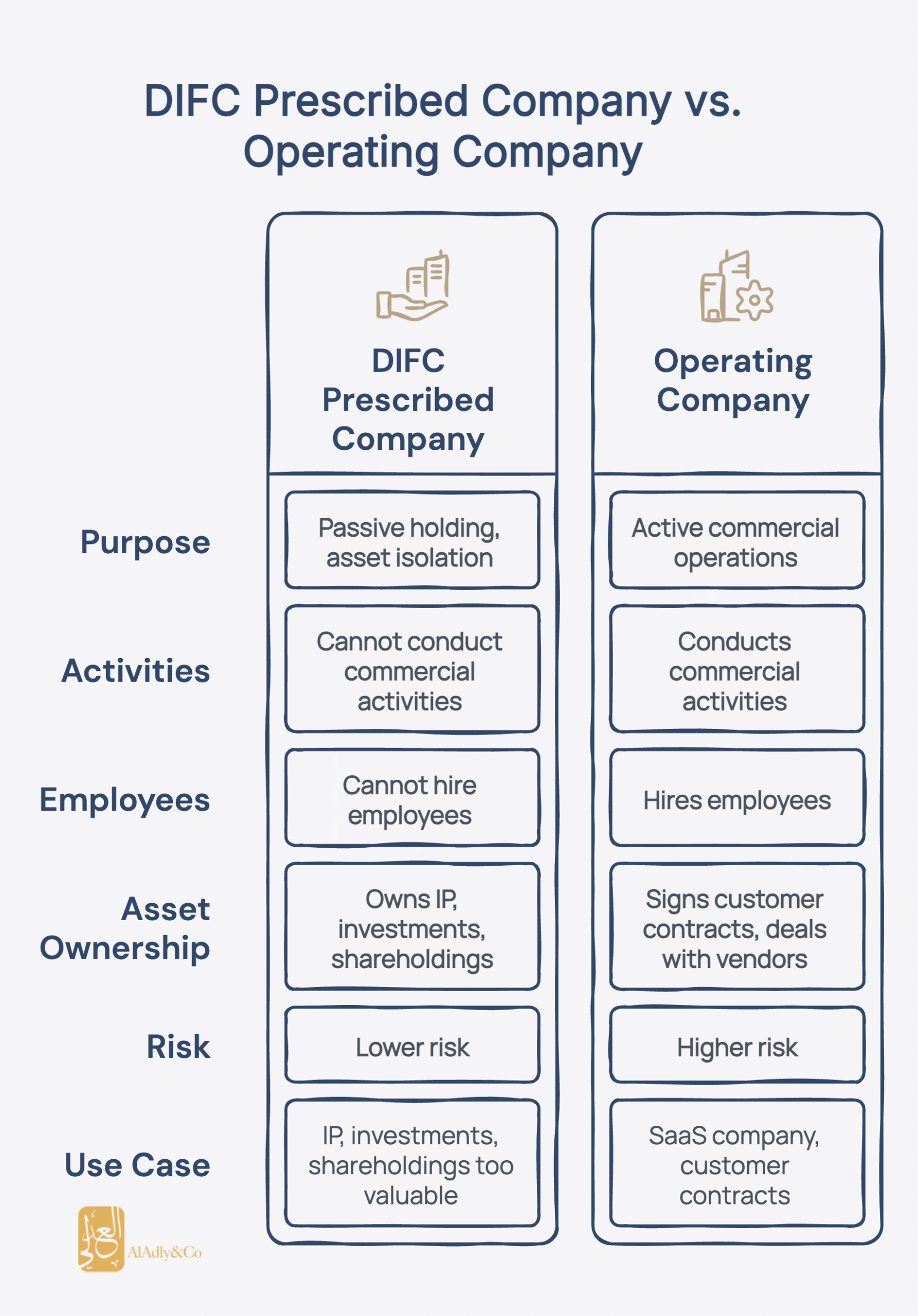
A DIFC Prescribed Company, often described as an SPV, is a passive holding company used to ring-fence and isolate assets and liabilities from financial and legal risk. DIFC describes SPVs as passive holding companies that are typically used to protect assets, and notes that they cannot conduct commercial or operational activities or hire employees.
For founders, this can be particularly useful where intellectual property is central to the business. Imagine a SaaS company whose operating entity signs customer contracts, hires staff and deals with vendors. If that same entity owns the core software IP, the most valuable asset sits inside the highest-risk company.
A more resilient model may be to place the IP in a DIFC SPV and license it to the operating company on arm’s-length terms. If properly structured and maintained, the intellectual property may remain insulated from certain operational liabilities affecting the operating company. This requires careful drafting, transfer-pricing awareness, correct accounting treatment and consistency between the contracts and the actual flow of value. For founders in software, digital assets or regulated technology, the IP structure should also align with the broader legal framework for protecting software IP and digital assets.
When to use it: Consider a DIFC SPV when your IP, investment assets or shareholdings have become too valuable to leave inside the operating entity.5. ADGM Foundation: A Long-Term Wealth Preservation and Succession Structure
For founders who have created significant value, the question eventually shifts from company setup to ownership continuity. Who controls the assets if the founder dies, becomes incapacitated, divorces, exits the business or transfers wealth to the next generation?
An ADGM Foundation can be useful where founders need a separate legal personality to hold assets according to a charter and by-laws. Unlike a simple contractual arrangement, a foundation can own assets in its own name and operate under a governance framework designed for long-term continuity.
This structure is not for every first-time founder. It becomes relevant when personal wealth, family governance, succession, cross-border assets or founder-control planning become central concerns.
When to use it: Consider an ADGM Foundation when the founder’s personal wealth, succession wishes and long-term ownership structure need a dedicated governance vehicle.6. Saudi LLC: The Vision 2030 Expansion Vehicle
Saudi Arabia has experienced significant economic growth in recent years, supported in part by Vision 2030 reforms and foreign-investment initiatives. For founders planning to sell into the Kingdom, hire locally or build a serious Saudi presence, a Saudi LLC may be the right operating vehicle.
Saudi Arabia’s investment framework has evolved. The MISA Investor Guide describes investment registration under the Investment Law and Executive Regulations, including registration for approved economic activities open to investment in Saudi Arabia. Clyde & Co. also explains in its analysis of the Saudi Investment Law Implementing Regulations that Saudi Arabia’s previous foreign-investment licensing approach has been replaced by a registration model, with foreign investors required to register with MISA before undertaking investment activities in the Kingdom.
This is helpful, but it does not mean every activity is open without conditions. Founders must still check approved activities, excluded or restricted sectors, capital requirements, local approvals, tax treatment and Saudization obligations.
When to use it: Use a Saudi LLC when Saudi Arabia is not just a sales destination, but a core market requiring local contracting, hiring, compliance and government-service access.7. RAK ICC Offshore Company: The International Holding Vehicle
A RAK ICC company can be useful where founders need a corporate vehicle to hold shares, international assets or non-UAE investments without requiring a UAE residency visa or local operating presence. It can be a practical holding tool for founders with cross-border assets, provided the structure is aligned with tax residency, banking, UBO disclosure and AML obligations.
The key is to be realistic about confidentiality. Administrative confidentiality does not mean invisibility. RAK ICC and similar structures remain subject to applicable anti-money laundering rules, beneficial-ownership disclosure requirements and international reporting standards.
When to use it: Consider a RAK ICC company for international asset holding where no UAE operating licence, local staff or UAE residency route is needed.Three Mistakes That Can Destroy Founder Protection
Even the best legal structure can fail if the company is operated poorly. In practice, the following mistakes are common because they appear small at first, but they can create major problems during disputes, audits, banking reviews or investor due diligence.
Mistake | Why it matters | Better approach |
|---|---|---|
Commingling finances | Personal and company funds become blurred, weakening the separation between founder and entity. | Use separate bank accounts, clean bookkeeping and documented reimbursements. |
Treating tax status as automatic | Free Zone 0% treatment depends on QFZP status, qualifying income and ongoing compliance. | Monitor revenue streams, substance, contracts, transfer pricing and audited financials. |
Using a branch instead of a subsidiary | A branch is usually not a separate legal entity, so parent-company exposure may remain. | Use a subsidiary where liability containment and local ring-fencing are important. |
The point is simple: a structure is only as strong as its daily operation. Founders should treat legal architecture as part of the business model, not as paperwork completed after the commercial plan is already fixed. If the company will operate across regulated sectors such as payments, crypto, open banking or financial technology, the structure should also be reviewed together with fintech legal services in the UAE and Egypt so licensing, AML/KYC, data protection and corporate ownership are aligned from the beginning.
How to Choose the Right Structure

A founder should not choose between Mainland, Free Zone, DIFC, ADGM, Saudi Arabia, Egypt or RAK ICC based only on setup cost. The right structure depends on how the business earns revenue, where the customers are, what assets must be protected, how the company will raise capital and which jurisdiction will carry the most operational risk.
If your main priority is... | Start by considering... |
|---|---|
UAE domestic sales and direct contracting | UAE Mainland LLC |
International services, SaaS or consulting from the UAE | UAE Free Zone company |
Egypt market entry or nearshoring | Egypt LLC |
Protecting software IP or investment assets | DIFC Prescribed Company |
Founder wealth and succession planning | ADGM Foundation |
Serious Saudi market entry | Saudi LLC |
Holding foreign assets or shares without UAE operations | RAK ICC company |
Conclusion: Build the Legal Architecture Before the Pressure Arrives
At AlAdly & Co., we believe founders need legal guidance that is practical, jurisdiction-aware and connected to real business decisions. The most successful founders do not simply set up a company. They build an architecture around how the business will operate, own assets, raise capital and expand.
A Mainland or Free Zone company may be the right operating base. A DIFC or RAK ICC vehicle may be the right asset holder. An ADGM Foundation may be appropriate for long-term continuity. A Saudi LLC or Egypt LLC may be essential for serious regional expansion.
The right answer depends on your activity, ownership model, tax position, investor plans and risk profile.
If you are planning to enter the MENA market, or if your current structure no longer fits the business you have built, speak with the corporate team at AlAdly & Co. before a dispute, audit, funding round or expansion deadline forces the issue.
Book a complimentary consultation with AlAdly & Co. to review your business model and design a structure that protects your assets, supports growth and keeps the next move executable.
Ahmed Adly
Founder & Managing Partner
Ahmed Adly is the founder and managing partner of Al Adly & Co, advising international businesses and entrepreneurs operating in the UAE and Egypt. With more than 20 years of legal experience and a background in senior government legal roles, he helps clients navigate regulatory complexity, structure transactions, and resolve high-value disputes.