


By: Ahmed Adly, Founder of Al Adly & Co.
Key Takeaways
If you're launching or expanding a crypto platform into Dubai, the VARA licensing route will shape your entity setup, approval sequence, and launch timing.
This guide explains who typically needs a VARA license, which licensed activities matter most, what VARA reviews during the application process, and where applications usually slow down.
- Who typically needs a license: Exchanges, broker-dealers, custodians, advisory firms, lending platforms, NFT marketplaces, and other virtual asset service providers operating in or from Dubai
- What determines the licensing route: Your activity mix, client profile, custody model, entity structure, and whether you market to or onboard Dubai-based users
- What VARA looks for: Local substance in Dubai, fit-and-proper responsible individuals, AML/KYC controls, technology and security standards, and activity-specific capital
- Where delays usually happen: Misclassified activities, weak compliance manuals, incomplete disclosures, and governance gaps
- How to reduce friction: Map the business model early, choose the right structure, and prepare the application package before you submit
The Reality Most Crypto Platforms Face
Expanding into Dubai is rarely just a licensing formality.
Most crypto platforms are trying to solve several issues at once:
- regulatory scope that depends on the exact business model
- banking sensitivity, even for licensed businesses
- gaps between US, EU or UK structures and UAE expectations
- internal pressure to launch quickly without creating compliance issues
A clear Dubai-specific roadmap helps align licensing, entity setup, AML/CFT, banking, and operational readiness before small issues turn into costly rework.
What Is a VARA License in Dubai — And Who Needs It?

A VARA license is the authorisation required to provide in-scope virtual asset services in or from Dubai, outside the DIFC. Whether your business needs one depends on what the platform actually does—not just whether it is labelled as a crypto exchange, Web3 startup, DeFi project, or token platform.
If your business facilitates exchange, brokerage, custody, lending, transfer, investment management, advisory, issuance, or similar regulated virtual asset activity involving Dubai users or Dubai operations, VARA licensing may apply. Foreign groups can also trigger VARA requirements if they actively market to or onboard Dubai-based clients.
The practical question is not simply “Are we a crypto business?” It is “Which regulated activities are we carrying on, through which entity, for which users, and with what custody or control features?” Operating without the appropriate license can lead to fines, cease-and-desist action, and disruption to local operations.
The sections below explain how VARA works, which businesses fall within scope, and what a compliant licensing path typically requires.
What Is VARA and Why It Matters?
VARA is Dubai's dedicated virtual asset regulator, established under Law No. (4) of 2022 and operationalised through the Virtual Assets and Related Activities Regulations 2023. It regulates virtual asset service providers operating in or from the Emirate of Dubai, excluding the DIFC, which has its own regime under the DFSA.
For founders, legal teams, and compliance officers, VARA matters because it affects licensing, marketing, governance, AML/CFT, custody, technology controls, and ongoing supervision. It also matters to banks, institutional partners, and counterparties assessing whether your regional setup is credible and compliant.
For a broader understanding of how VARA fits into the UAE's legal framework for virtual assets, see our overview on Is cryptocurrency legal in UAE?. If you are still deciding between Dubai, ADGM, and DIFC, treat that choice as a structuring decision before starting the licensing process.
Who Needs a VARA License in Dubai?
VARA licensing is activity-based. The need for a license depends on what your business actually does with virtual assets, not just its branding as "exchange," "DeFi protocol," or "Web3 startup."
Main types of businesses and virtual asset activities requiring a VARA license:
Activity Type | Description |
|---|---|
Centralised exchanges | Operating order books/ marketplaces for VA trading (spot and, where permitted, derivatives) |
Broker-dealers and OTC desks | Arranging, dealing, and facilitating trades for clients |
Custodians and wallet providers | Safekeeping and administering client virtual assets |
Portfolio/investment managers | Managing virtual asset portfolios for clients |
Advisory firms | Professional VA investment or structuring advice |
NFT platforms and token issuers | Marketplaces and issuance where tokens meet VARA definitions |
Lending/borrowing platforms | Providing credit or staking-as-a-service involving virtual assets |
Important distinctions:
- Proprietary trading and treasury management by a group entity may require separate structuring from licensed client-facing VASP activities
- Foreign virtual asset platforms without a physical Dubai office can trigger VARA requirements if they actively market to or onboard Dubai clients
- If you're unsure whether your platform falls within scope, seek a formal regulatory assessment before committing to a structure
Types of VARA Licenses and Licensed Activities
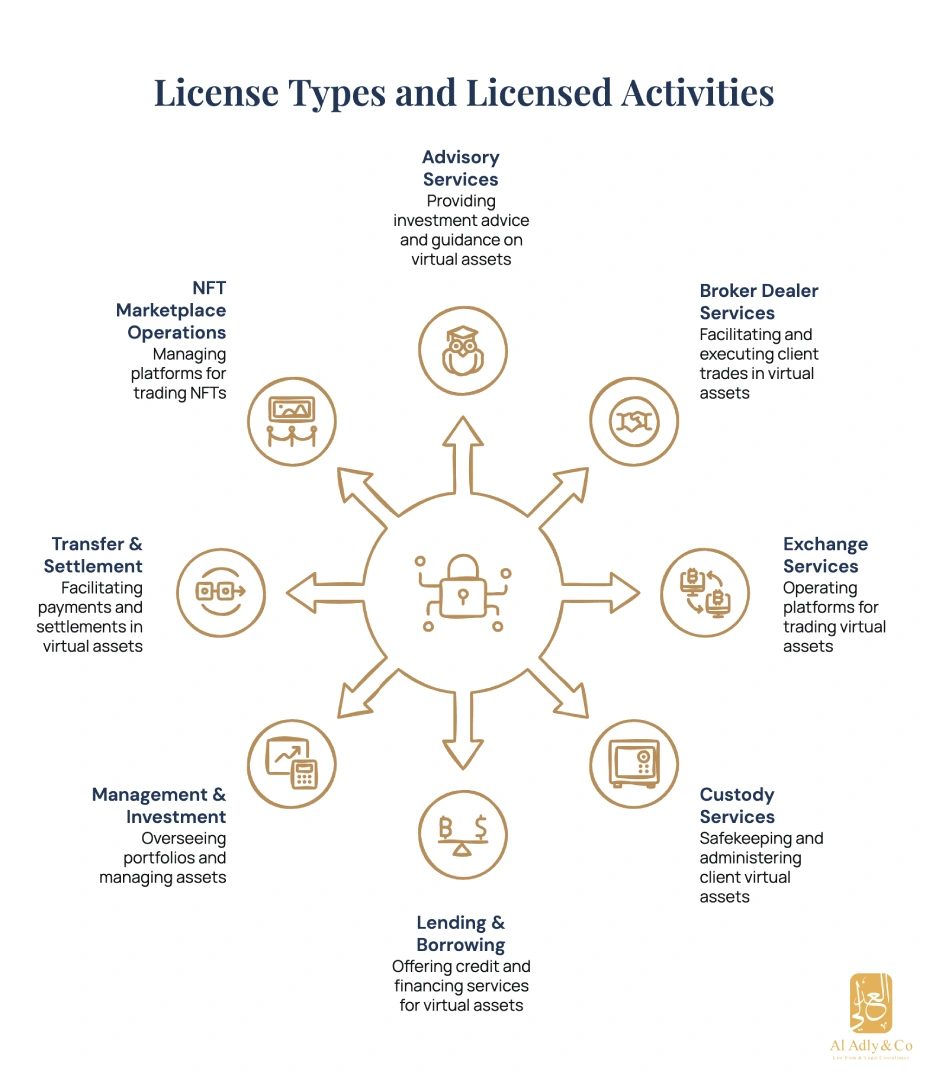
VARA licenses are granted per activity category. A single VASP may hold multiple licensed activities under one entity — with one critical exception: custody services must be segregated into a distinct legal entity with its own dedicated license.
Primary licensed activity types:
- VA Advisory Services: Investment advice, structuring, or guidance on using virtual assets
- VA Broker Dealer Services: Arranging, dealing, and order-matching for client trades
- VA Exchange Services: Operating order books, trading platforms, or marketplaces
- VA Custody Services: Safekeeping and administration of client assets (separate entity required)
- VA Lending & Borrowing: Credit or financing-related virtual asset services
- VA Management and Investment Services: Portfolio oversight and asset management
- VA Transfer and Settlement Services: Facilitating payment and settlement in virtual assets
- NFT Marketplace Operations: Where applicable under VARA definitions
Here's what you need to know:
- Custody must be ring-fenced in a separate legal entity to protect investors
- Proprietary trading by the VASP is restricted under the client-facing license — usually requiring a separate unregulated group entity
- Each license type has distinct capital requirements, systems expectations, and compliance standards
- Misaligning the license category with your actual activities is a frequent cause of regulatory friction and rejection
The "Requirements" and "Process" sections below detail what each license type generally entails from a governance and documentation standpoint.
Step-by-Step VARA Licensing Process in Dubai

Here's how the process works in practice. You get a clear roadmap that removes uncertainty and accelerates your approval, if you follow these steps when planning your VARA license application.
Step 1: Business Model and Regulatory Mapping
Map your precise virtual asset activities, client types (retail clients vs qualified investors), and geographic scope. This should result in a regulatory memo indicating which VARA categories apply and whether VARA, ADGM, or DIFC is the better fit for your business model.
Step 2: Choose Jurisdiction and Legal Form
Decide between Dubai mainland and free zones such as DWTC authorised to host VASPs. Your choice affects corporate ownership, office space options, and sometimes banking relationships, but VARA authorization is required regardless for covered activities.
Step 3: Entity Incorporation and Physical Presence
Reserve a trade name, draft MOA/Articles, obtain an initial trade license, and secure a compliant office lease in Dubai. VARA requires real operational presence, not just a paper entity.
Step 4: Initial Disclosure and Pre-Application
Prepare and submit VARA's Initial Disclosure Questionnaire (IDQ), including your business model description, ownership structure, governance overview, and high-level financials. VARA may ask clarifying questions before accepting the full application.
Step 5: Full VARA Application Submission
Submit the complete package:
- Detailed regulatory business plan
- Compliance manuals (AML/KYC, market abuse, conflicts of interest)
- Technology and cybersecurity descriptions
- Risk management framework
- CVs of key individuals and senior management
Pay initial fees required at this stage. Timeframes become sensitive to completeness of your submissions.
Step 6: Compliance, Systems, and Operational Readiness
Demonstrate that your systems (trading engine, custody infrastructure, wallets, monitoring tools) are in place and meet regulatory standards. Appoint a Compliance Officer, MLRO, and two Dubai-based responsible individuals who meet "fit and proper" criteria.
Step 7: VARA Review, Conditions, and Final License
VARA may respond with follow-up questions or conditions. Once satisfied, VARA issues an Initial Approval or Full Market Product License for your approved activities, subject to ongoing reporting and annual supervision fee obligations.
If you're planning to enter the UAE, the fastest way to move forward is to get clarity early. Consider contacting an experienced Crypto Lawyer in Dubai in advance, to get a step-by-step VARA licensing roadmap tailored to your platform.
Key VARA Licensing Requirements in Dubai

Beyond application forms, VARA focuses on five pillars. Each must be clearly demonstrated in your submission.
Capital Requirements
Minimum paid-up capital and ongoing expense-based thresholds vary by activity — typically starting in the tens of thousands of USD equivalent and increasing significantly for exchanges and custodians. Capital must be maintained in approved UAE accounts with VARA-recognised protections.
Governance and Management
You need a competent board and senior management with a clear division of responsibilities. At least two full-time Dubai-based responsible individuals must satisfy fitness and propriety standards.
AML/KYC and Compliance Framework
You need to implement an anti-money laundering program consistent with UAE federal laws and VARA rulebooks, including CDD, EDD, sanctions screening, transaction monitoring, and suspicious transaction reporting. For more detail, see our guide on AML/KYC requirements in the UAE.
Technology, Security, and Custody Controls
Your platform must demonstrate robust IT security (encryption, access controls, incident response), wallet management procedures using distributed ledger technology, segregation of client and firm assets, and cold/hot wallet strategies where relevant. Independent audits and penetration testing are typically expected.
Local Presence and Substance
VARA requires real economic substance: physical office space in Dubai, core team members on the ground, and decision-making happening from the licensed entity. Outsourcing is allowed for some functions but cannot hollow out the regulated core of your business operations.
Well-prepared documentation on these pillars significantly reduces VARA queries and speeds up the review process.
Timeline and Common Bottlenecks for a VARA License
There is no fixed, guaranteed timeline. You should plan for a multi-month process rather than expecting immediate approval.
Indicative stages:
Stage | Typical Duration |
|---|---|
Internal strategy and business model mapping | 2–6 weeks |
Entity incorporation, office lease, pre-application | 4–8 weeks |
VARA review (initial disclosure to full license) | Several months |
Common causes of delay:
- Unclear or inconsistent business model that leaves VARA uncertain about your actual activities
- Incomplete or generic compliance manuals not tailored to your platform
- Weak or unproven governance and senior management experience
- Gaps in AML/KYC setup and transaction monitoring tools
No advisor can promise a fixed processing period or guaranteed approval. What you can control is preparation quality: a clear activity map, tailored compliance documents, credible governance, and a complete application package all reduce avoidable follow-up rounds.
Common Mistakes When Applying for a VARA Crypto License
Many otherwise strong crypto projects lose time and credibility due to avoidable errors.
Typical mistakes:
- Applying for the wrong license category or omitting key activities (e.g., including custody-like functions in an exchange-only license)
- Submitting generic, copy-paste policies not aligned with your actual platform architecture
- Underestimating AML/KYC and sanctions compliance, especially if your platform onboards users from higher-risk jurisdictions
- Ignoring local substance and banking considerations, leading to challenges in demonstrating operational readiness
- Failing to separate proprietary trading and treasury activities from client-facing VASP operations within your group structure
Early legal and regulatory input can prevent rework and re-submissions. A small structural change before applying can save you months of delay.
VARA vs ADGM vs DIFC: Which Framework Makes Sense for You?
Dubai's VARA, Abu Dhabi's ADGM (FSRA), and DIFC (DFSA in Dubai) are distinct regulatory frameworks with different licensing regimes.
Factor | VARA | ADGM | DIFC |
|---|---|---|---|
Jurisdiction | Dubai (excluding DIFC) | Abu Dhabi | Dubai (financial free zone) |
Focus | Virtual asset-specific | Broader financial services incl. VA | International finance hub |
Client types | Retail and professional | Primarily institutional | Institutional/professional |
Best for | Dubai branding, retail-friendly | Global institutional players | Cross-border financial services |
For deeper guidance, see our comparison on DIFC vs. ADGM vs. VARA. Jurisdiction choice should be a deliberate decision made before starting the licensing process — not an afterthought.
How to Get a VARA License Faster and With Less Risk
Speed and predictability come from structuring your application correctly from day one, not from shortcuts.
What works in practice:
- Run a structured regulatory and business-model workshop before incorporating any entity
- Decide on your group structure (operating entity, IP entity, custody entity, treasury entity) to align with VARA's treatment of activities
- Build a tailored compliance framework with real workflows — not just templates — covering onboarding, risk assessments, and transaction monitoring
- Pilot or test core technology (custody and trading infrastructure) before presenting it to VARA
An experienced legal partner can anticipate regulator questions, align your business documents with VARA expectations, and coordinate with corporate service providers, auditors, and banks for a coherent package.
Why Work With Al Adly & Co.
Most law firms in the UAE can explain VARA's rules. Fewer can help you actually navigate them across jurisdictions, under pressure, and with your business model in mind.
Here's what sets Al Adly & Co. apart:
- Cross-border expertise across UAE and Egypt
— Al Adly & Co has practised in both jurisdictions for over 20 years, with senior government legal roles including the Dubai Future Foundation and the Sharjah Investment and Development Authority (Shurooq) - Regulatory and dispute experience at the highest level
— including multi-million dirham arbitration awards before DIAC and the largest M&A transaction in the Emirate of Sharjah - Crypto and fintech-aware legal approach
— we understand the difference between a CEX and a DEX, between custody and self-custody, and between what regulators write and what they actually expect - Business-focused advice, not generic compliance
— we help you structure your expansion so it actually works, from entity setup to banking to ongoing supervision
We don't just explain VARA requirements. We help you build a structure that gets approved, stays compliant, and supports your growth.
Get Your VARA Licensing Roadmap

If you're planning to enter Dubai, start with a licensing and structuring assessment before you commit to an entity, application, or launch date.
In one consultation, we help you:
- Map your exact licensing requirements
- Identify structural risks before you apply
- Define a realistic timeline and setup plan
Take the next step:
Or WhatsApp us for a quick feasibility check.
Early engagement reduces cost, delays, and rework compared with approaching lawyers only after a rejected or stalled application.
FAQs: VARA License in Dubai
These questions address practical concerns based on common queries from founders and compliance teams. Answers are general. Businesses seeking specific advice should consult qualified counsel.
How long does it usually take to obtain a VARA license?
There is no fixed VARA licensing timeline. In practice, many applications take several months from planning to approval, with timing driven by the business model, application quality, governance readiness, and how quickly follow-up questions are resolved.
Straightforward models may progress faster. Exchange, custody, lending, or multi-entity structures usually take longer because they require more detailed review.
Can foreign-owned companies apply for a VARA crypto license in Dubai?
Yes. 100% foreign ownership is generally possible in many Dubai free zones and is common among international VASPs. However, VARA still requires real local presence: a Dubai-registered legal entity, physical office, and locally based responsible individuals.
Group structures often involve a foreign parent company with a Dubai subsidiary as the VARA-licensed operating entity.
Do I need a local entity if my platform is already licensed abroad?
An existing license in another country does not replace VARA authorization if your platform targets clients in or from Dubai. You will need to set up a local entity that becomes the regulated VASP under VARA, even if risk and technology are shared with the foreign parent.
Multinational groups should plan intra-group agreements (IP licensing, service arrangements) in parallel with the VARA application to facilitate cross-border operations.
Does VARA regulate all DeFi and Web3 projects targeting Dubai?
It depends on the specific design. VARA's scope covers the degree of centralisation, control over protocols, custody of user assets, and economic reality of the service. Projects with meaningful centralised elements (admin keys, fee collection, central front-ends) may still be considered VASPs requiring licensing.
You should obtain a regulatory analysis early rather than assuming "DeFi" branding automatically places your project outside VARA's scope.
What are the consequences of operating in Dubai without a VARA license?
Providing in-scope virtual asset services without authorization can result in regulatory action, including fines, orders to cease activity, and reputational damage affecting banking and partner relationships. Unlicensed activity may also create contractual and liability risks.
If you're currently serving Dubai users without a VARA license, you should seek immediate legal advice on regularisation options or restructuring.
Disclaimer
This article content is for general informational purposes only and does not constitute legal, tax, or regulatory advice. Readers should not regard this information as a substitute for obtaining tailored advice from qualified counsel on their specific circumstances. VARA regulations and related UAE laws continue to evolve, and requirements, processes, and interpretations may change after publication.
Ahmed Adly
Founder & Managing Partner
Ahmed Adly is the founder and managing partner of Al Adly & Co, advising international businesses and entrepreneurs operating in the UAE and Egypt. With more than 20 years of legal experience and a background in senior government legal roles, he helps clients navigate regulatory complexity, structure transactions, and resolve high-value disputes.