

By: Ahmed Adly, Founder of Al Adly & Co.
Imagine this: your construction project in Dubai, a symbol of growth and progress, suddenly comes to a halt. Not through any fault of your own, but due to an unforeseeable event—a global pandemic, a sudden political crisis, or a natural disaster. Your contracting partner is threatening to impose significant penalties for the delay. In these moments, the force majeure clause transforms from a legal subtlety into a critical instrument for your company’s survival. In the dynamic economic environment of the United Arab Emirates (UAE), understanding this clause is not an option, but a necessity.
As a strategic legal partner for ambitious businesses, we at AlAdly & Co. navigate our clients through precisely such complex scenarios. We help you not only to overcome legal challenges but to turn them into strategic advantages. This guide provides you with the clarity and depth needed to fully grasp the significance of force majeure in UAE law.
Key Takeaways at a Glance
Strategic Aspect | Detailed Description |
|---|---|
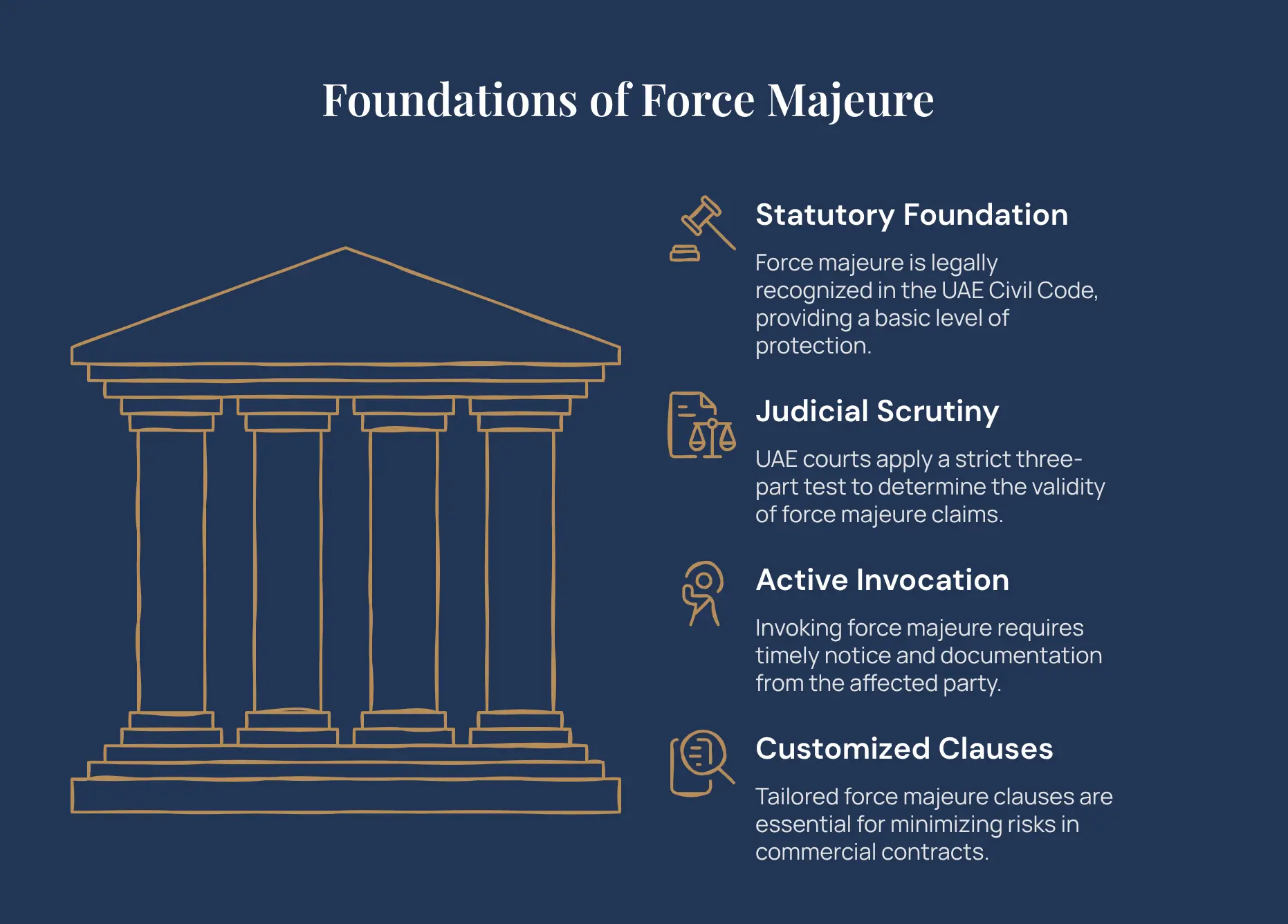
Statutory Foundation | Force majeure is enshrined in Article 273 of the UAE Civil Code. This means the principle can apply even without an explicit clause in your contract, providing a fundamental layer of security. |
Strict Judicial Scrutiny | UAE courts apply a stringent three-part test: the event must be unforeseeable, uncontrollable, and the direct cause of the impossibility of performance. Mere difficulty or increased cost is not sufficient. |
Not Automatic | Invoking force majeure is an active process. The affected party must provide the other party with timely notice and present complete documentation to suspend its contractual obligations. |
Customized Clauses | A standard clause is rarely adequate. A precise force majeure clause, tailored to your business, is crucial for minimizing risks in commercial contracts and safeguarding the interests of both contracting parties. |
What Exactly Does “Force Majeure” Mean?
The term force majeure originates from French and means “superior force.” In contract law, it refers to a clause that relieves a party from its contractual obligations when performance becomes impossible due to an exceptional, unforeseeable, and uncontrollable event. It is a legal safety net for situations that are beyond the party’s control.
Typical Force Majeure Events
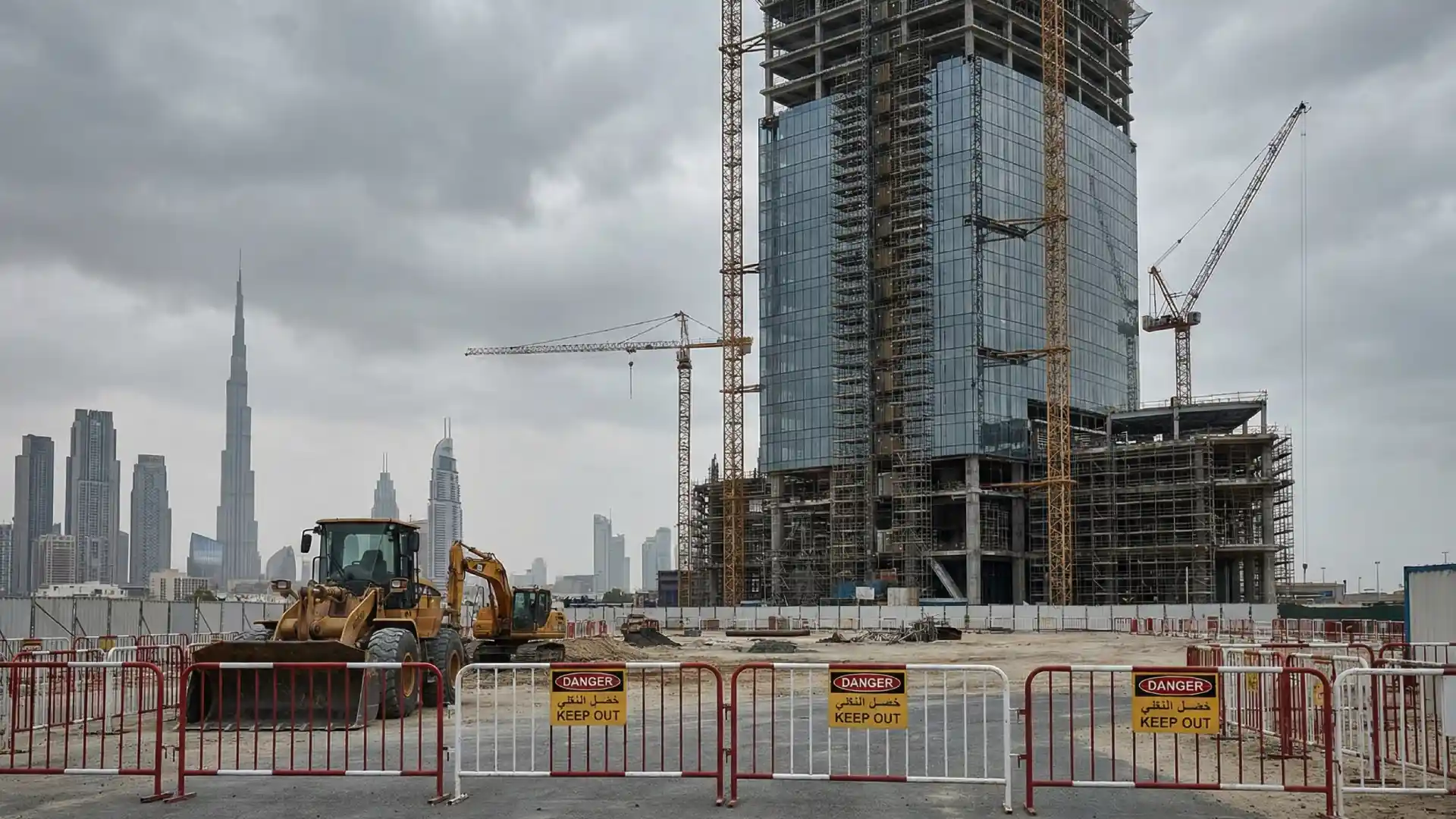
A well-drafted force majeure clause lists specific force majeure events. These may include:
The Crucial Difference: Civil Law vs. Common Law Under the New Law
A critical point that international business partners often overlook is the difference between legal systems. The UAE is a civil law jurisdiction, in contrast to common law systems like in the UK, the US, or Australia. This has significant implications for the application of force majeure, especially under the new Federal Law No. 25 of 2025, which takes effect on 1 June 2026 and comprehensively replaces the 1985 Civil Code.
In Common Law, force majeure must be explicitly defined in the contract. Without a clause, there is little room to be excused from performance. In the UAE’s Civil Law framework, however, force majeure is a principle enshrined in statute—even without a specific clause, a party can invoke the statutory provisions.
Article 236 of the New UAE Civil Transactions Law (Federal Law No. 25 of 2025) Article 236 replaces the former Article 273 (from the 1st of june 2026 onwards) as the core provision for contract termination due to force majeure. It provides that in bilateral contracts, where a force majeure event renders the performance of an obligation entirely impossible, the reciprocal obligations of the parties lapse and the contract is dissolved ipso jure (by operation of law). In cases of partial impossibility, either party may insist that the corresponding part of its obligation lapse or petition the court for rescission of the entire contract. For temporary impossibility in continuous contracts, the affected party may request the suspension of the obligation, a modification of the contract, or its rescission if continuation is no longer viable.
A Broader Web of Provisions
The new law distributes the rules on force majeure across several specific articles, allowing for more precise application depending on the contract type. Beyond the central Article 236, the following provisions are relevant:
Article 249 addresses “exceptional circumstances” (hardship): where performance is not impossible but becomes excessively onerous, a court may adjust the contractual obligations—an important instrument that complements force majeure. In addition, the new law contains sector-specific rules in Articles 748, 749, 753, 804, 837, 1030, and 1365, which further specify the application of force majeure for particular contract types—such as construction, lease, or service agreements. This new structure demands an even more careful examination of the specific contractual context.
When Can You Successfully Invoke Force Majeure in the UAE?
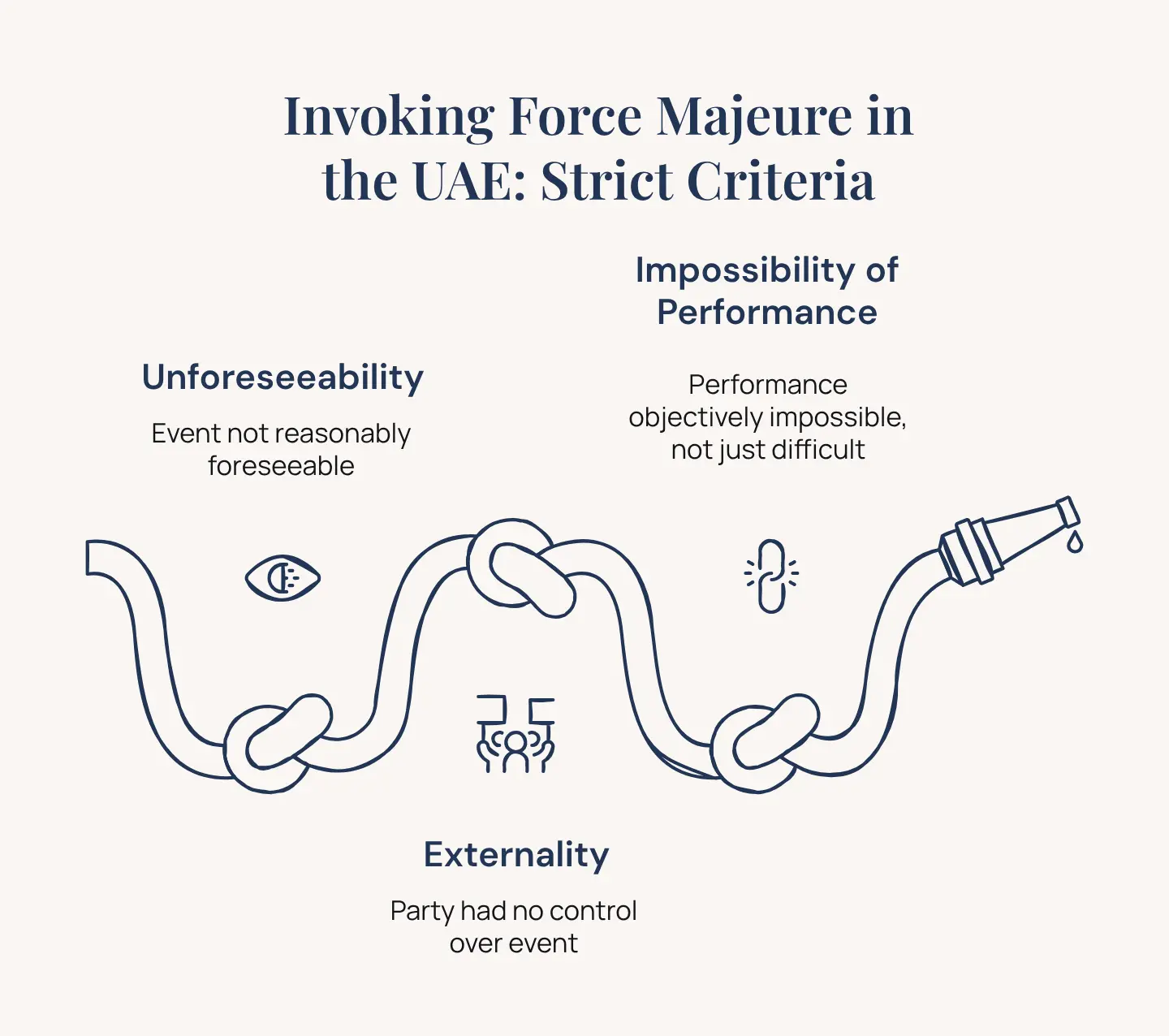
Invoking force majeure is not an easy way out. The courts in the UAE apply three strict criteria that the affected party must prove:
The Process: How to Correctly Invoke Force Majeure
When a force majeure event occurs, swift and methodical action is crucial. A mistake in the process can nullify your rights.
- Immediate Notification: The affected party must provide the other party with timely notice of the force majeure event and its expected impact on contract performance as soon as possible. The deadlines for this are often specified in the force majeure clause itself.
- Detailed Documentation: Collect all evidence: official orders, weather reports, news articles, correspondence with suppliers. You must prove that the event renders performance impossible.
- Duty to Mitigate: The affected party must demonstrate that it has taken reasonable steps to mitigate the effects of the event or to find alternative solutions.
Crafting a Bulletproof Force Majeure Clause
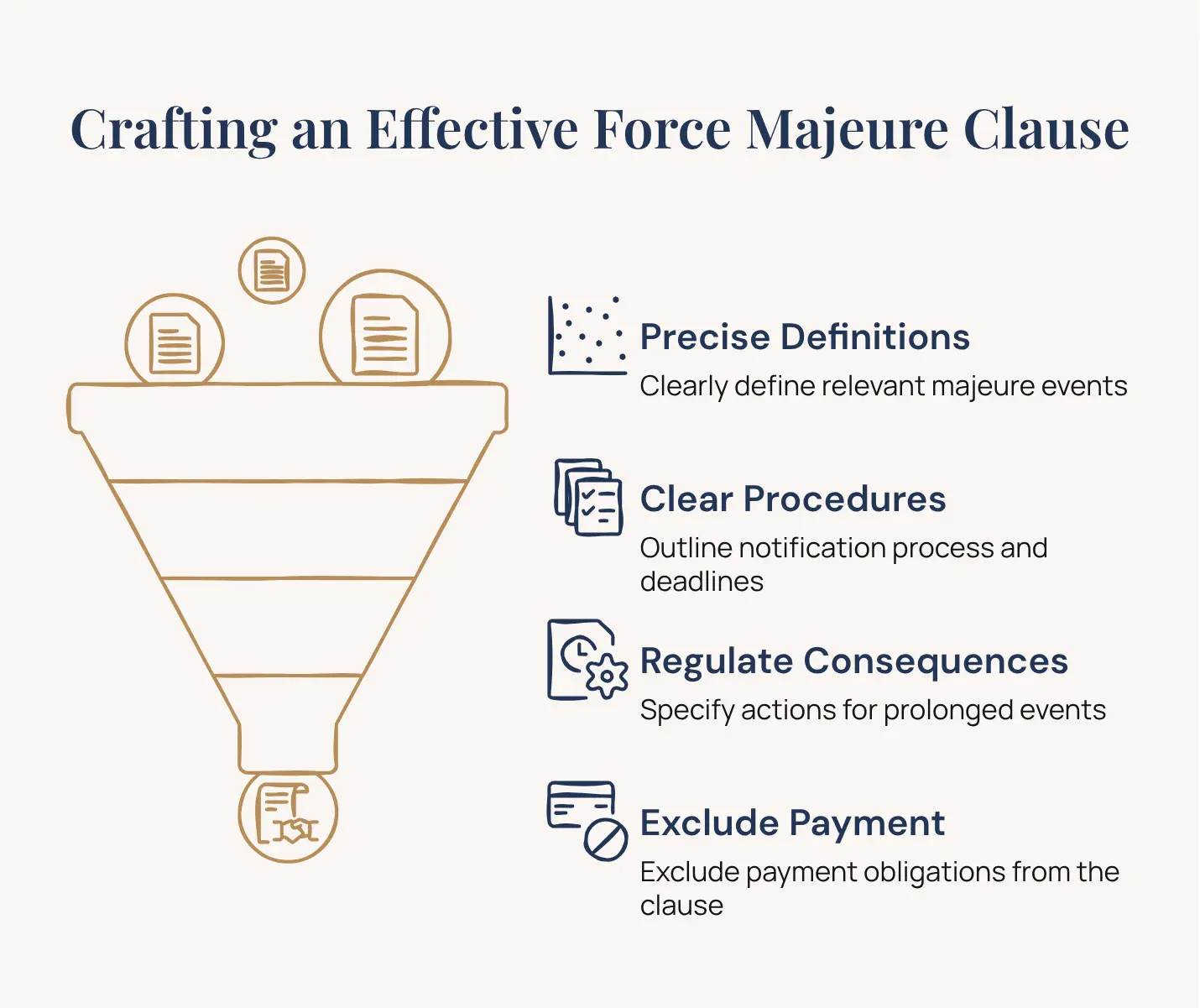
Copying a standard clause from the internet is a serious mistake. An effective force majeure provision is a customized instrument that must be carefully drafted by your legal and commercial teams. It should include the following:
- Precise Definitions: A non-exhaustive list of majeure events relevant to your industry.
- Clear Procedures: Exact instructions on the notification process, including deadlines and required content of the notice.
- Regulation of Consequences: What happens if a force majeure event continues? Is performance merely suspended? For how long? When does a party have the right to terminate the contract?
- Exclusions: It is common to exclude payment obligations from the application of the force majeure clause.
Frequently Asked Questions (FAQ)
Q: Does an economic crisis qualify as force majeure?
A: Generally, no. Economic difficulties, currency fluctuations, or market changes are usually considered part of the general business risk and not unforeseeable events in the sense of force majeure.
Q: What is the difference between a force majeure and a “hardship” clause?
A: A hardship clause applies when contract performance has become not impossible, but excessively burdensome or economically ruinous. It often leads to a renegotiation of the contract, whereas force majeure suspends or terminates the obligations hereunder.
Q: Can I invoke force majeure if my supplier fails?
A: That depends on your clause. A well-drafted clause will specify this. Typically, you must prove that the supplier’s failure is itself due to a force majeure event and that you could not find an alternative source.
Your Strategic Partner in UAE Contract Law
The complexity of force majeure requires careful consideration and strategic foresight. An error in contract drafting or in handling a force majeure event can lead to significant financial losses and lengthy legal disputes.
At AlAdly & Co., we combine deep legal knowledge with a keen understanding of your business objectives. We help you proactively manage risks and protect your interests.
Whether you need a customized force majeure clause for your commercial contracts, are in the midst of a dispute, or are seeking strategic advice on risk minimization—our team of experienced lawyers is at your side.
Contact us for a strategic initial consultation:
- For drafting and reviewing your contracts: Commercial & Corporate Law
- For legal disputes in court: Litigation
- For out-of-court dispute resolution: Arbitration

Ahmed Adly
Founder & Managing Partner
Ahmed Adly is the Founder and Managing Partner of Al Adly & Co., advising international businesses and entrepreneurs operating in the UAE and Egypt. With more than 20 years of legal experience and a background in senior government legal roles, he helps clients navigate regulatory complexity, structure transactions, and resolve high-value disputes.