


Author: Neethi Zenith, Senior Legal Consultant, Al Adly & Co
Key Takeaways for Busy Executives
Area | What Changed | What You Must Do |
|---|---|---|
Jurisdiction | The UAE operates three parallel data regimes (PDPL, DIFC, ADGM) | Map whether your entity falls under federal law or free zone regulations |
DPIAs | Mandatory for high-risk AI processing | Conduct Data Protection Impact Assessments; DIFC fines reach USD 50,000 for non-compliance |
Transparency | DIFC Regulation 10 specifically targets autonomous systems | Disclose automated decision-making and provide meaningful logic explanations |
Cross-Border | AI systems often rely on international data flows | Use SCCs or adequacy mechanisms; PDPL regulations remain pending |
Penalties | Consequences are escalating across all jurisdictions | Prepare for fines up to AED 5 million, criminal liability, and new private claims in the DIFC |
Why Your AI Strategy Needs a Legal Foundation Now
The United Arab Emirates continues to lead in artificial intelligence adoption, driving economic growth and efficiency across sectors. However, this innovation intersects with stringent data protection requirements, creating complex compliance challenges for businesses. If you are a FinTech founder scaling into MENA or a crypto platform preparing for regional launch, this intersection is no longer theoretical. It is a critical operational risk.
As the UAE advances its National AI Strategy 2031, regulators are scrutinizing how autonomous systems process personal data. AI is not a compliance-free zone. The UAE's data protection frameworks apply with full force to AI-driven processing. Supervisory attention is intensifying.
For platforms utilizing AI for credit scoring, automated KYC/AML screening, or algorithmic trading, navigating UAE AI data protection compliance is essential. However, data protection is only one layer. If your platform processes transactions or handles financial flows, you must also meet strict AML/CFT obligations. The difference between a successful launch and a regulatory roadblock often comes down to how well your legal architecture supports your technological ambitions. Understanding the regulatory landscape for crypto businesses is therefore a critical first step.
The UAE's Multi-Jurisdictional Data Protection Framework
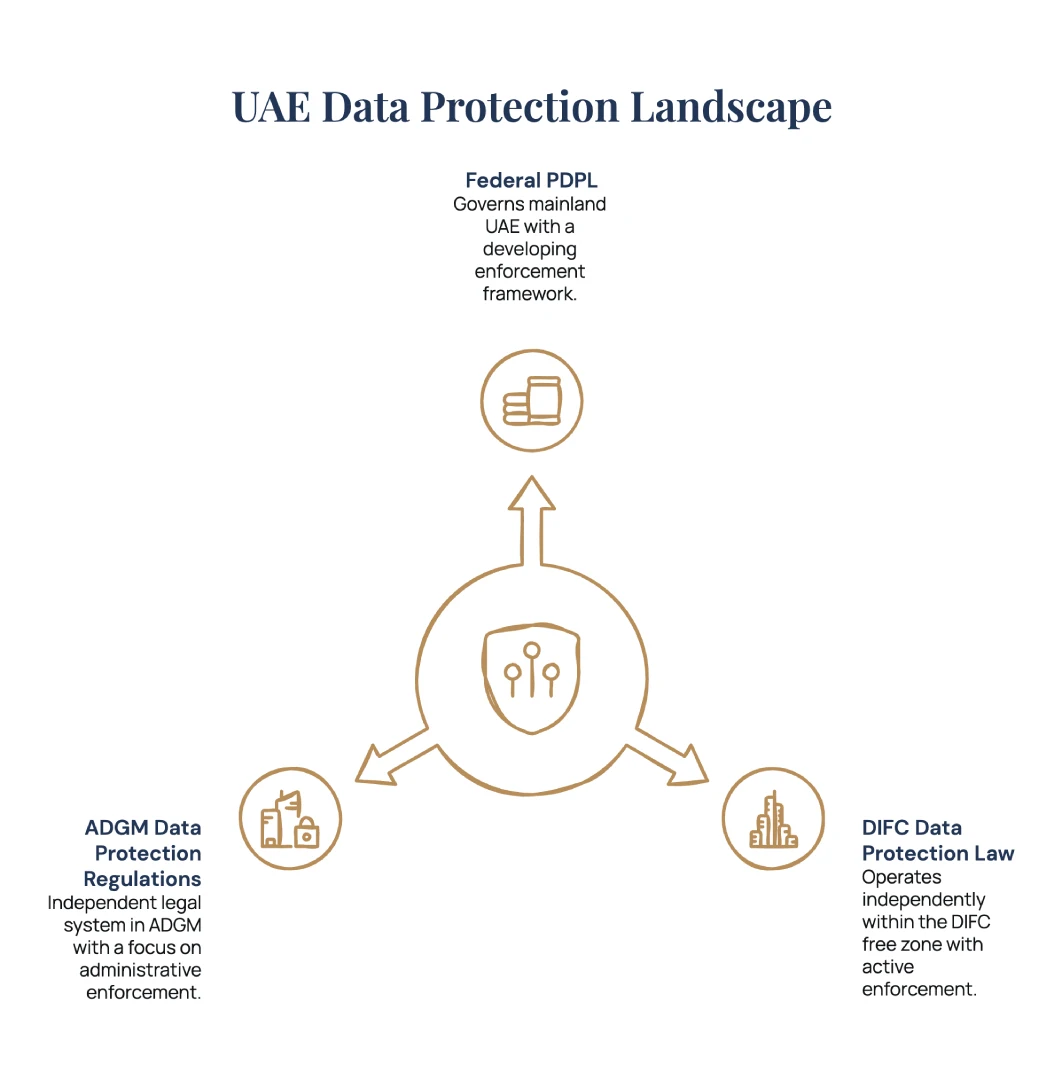
The UAE's approach to data protection is not monolithic. Entities must navigate three parallel regimes depending on their location and licensing structure. This creates a regulatory patchwork requiring businesses to carefully determine which regime—or combination of regimes—applies to their operations. Free zone regimes (DIFC and ADGM) apply instead of the federal PDPL for entities incorporated in those zones. All three frameworks treat AI-driven processing as falling squarely within their scope.
1. Mainland UAE (Federal PDPL)
The primary legislation is Federal Decree-Law No. 45 of 2021 on the Protection of Personal Data (PDPL). It applies to any controller or processor managing the personal data of UAE residents, regardless of the entity's location, giving it extraterritorial reach. While the law came into effect in January 2022, full compliance is required by 1 January 2027. Enforcement will be overseen by the UAE Data Office.
2. Dubai International Financial Centre (DIFC)
Entities in the DIFC are subject to DIFC Data Protection Law No. 5 of 2020, a mature GDPR-aligned framework. Crucially, July 2025 amendments introduced a private right of action, allowing data subjects to claim compensation for contraventions of their rights—including non-financial loss such as distress. This significantly lowers the barrier to litigation.
3. Abu Dhabi Global Market (ADGM)
The ADGM operates under the ADGM Data Protection Regulations 2021, also closely aligned with international standards. Recent developments include the Data Protection Regulations (Substantial Public Interest Conditions) Rules 2025, providing greater clarity on the processing of special categories of personal data.
What this means for you: You cannot rely on a generic, one-size-fits-all privacy policy. Your compliance approach must be mapped precisely to your licensing jurisdiction. This is where working with experienced FinTech legal counsel prevents costly structural mistakes.
AI Governance: Policy Frameworks Over Standalone Legislation
As of 2026, the UAE has not enacted a dedicated, comprehensive AI statute like the EU AI Act. Instead, AI governance is shaped through a hybrid model that blends national policy, ethical guidelines, and existing legal instruments. This reflects the UAE's pragmatic, innovation-friendly stance.
Key instruments guiding this approach include
- UAE National AI Strategy 2031: Aims to position the UAE as a global AI leader with strong governance.
- UAE Charter for the Development and Use of AI (2024): A guiding framework covering human oversight, data privacy, transparency, and fairness.
- Dubai Ethical AI Toolkit (2019): Launched by Smart Dubai to provide practical advice on fairness, accountability, and explainability.
Where Data Protection Law Intersects with AI Systems
AI systems inherently rely on large-scale data processing, often involving personal and sensitive data. Below are the most critical intersections where FinTechs and crypto platforms face compliance risks.
Lawful Basis and Sensitive Data
AI systems cannot process personal data without a valid legal basis. Obtaining informed consent for AI-driven processing can be challenging, especially where automated decision-making is involved. For AI use cases involving sensitive data—such as biometrics for KYC onboarding or profiling that reveals protected characteristics—heightened safeguards apply.
Transparency and Automated Decision-Making
Under the PDPL and free zone laws, data subjects have the right to understand how their data is used. However, machine learning models often operate as "black boxes." DIFC Regulation 10, introduced in late 2023, specifically addresses the processing of personal data through autonomous and semi-autonomous systems. It requires controllers to provide additional information to data subjects and recognize the right to object to processing in the context of profiling and automated decision-making.
Data Protection Impact Assessments (DPIAs)
DPIAs are mandatory for high-risk processing activities, including many AI use cases. Under the DIFC regime, failure to conduct a DPIA before commencing high-risk processing can result in fines of up to USD 50,000. Organizations must conduct comprehensive data mapping to understand how personal data flows through their AI systems.
What this means for you: If your platform uses AI to approve loans, flag suspicious transactions, or personalize investment advice, you must be able to explain the logic behind those decisions to regulators and users alike.
Penalties and Regulatory Consequences: What Is at Stake
The UAE has established a rigorous penalty regime for data protection violations, with consequences that should command the attention of any boardroom.
Jurisdiction | Penalty Range | Key Updates |
|---|---|---|
Federal (PDPL) | AED 50,000 to AED 5,000,000, plus potential criminal liability | Full compliance required by 1 January 2027 |
DIFC | Up to USD 50,000 per violation | July 2025 amendments introduced private right of action and new fines (up to USD 25,000 for DPO assessment failures) |
ADGM | Penalties under ADGM Regulations | Aligned with GDPR-style enforcement |
Criminal Liability | Imprisonment up to one year and fines of at least AED 20,000 | Applies to unlawful data disclosure |
Beyond financial penalties, businesses face potential suspensions, public disclosure of violations, and reputational damage. The introduction of private claims in the DIFC significantly increases litigation exposure. For platforms handling user data at scale, this is a material risk that demands board-level attention.
Cross-Border Data Transfers in an AI Context
AI systems often rely on cross-border data flows—whether for cloud processing, model training, or international service provision. The UAE's three regimes take different approaches, creating genuine compliance uncertainty.
While the DIFC and ADGM have clear adequacy lists and published Standard Contractual Clauses (SCCs) based on European models, the federal PDPL implementing regulations regarding adequacy and SCCs remain unpublished. For mainland entities, a prudent approach requires using contractual safeguards modeled on international standards and documenting the legal basis for each transfer.
A Practical Compliance Roadmap for Founders

Organizations adopting AI in the UAE should focus on these five essential steps:
- Map Your Jurisdiction:
Determine whether your entity falls under mainland PDPL, DIFC, ADGM, or a combination. - Conduct DPIAs:
Perform Data Protection Impact Assessments before deploying any AI system that processes personal data, particularly for high-risk activities. - Implement Transparency Measures:
Disclose to users when automated decision-making or profiling is used, and provide meaningful information about the logic involved. - Review Cross-Border Flows:
Ensure appropriate safeguards (SCCs, BCRs, or adequacy decisions) are in place for international data transfers. - Appoint a DPO:
esignate a Data Protection Officer for high-risk processing activities to ensure compliance and liaise with regulators.
How Al Adly & Co. Supports Your Innovation
Ahmed Adly founded Al Adly & Co. with a clear philosophy: We Bridge — connecting global standards with local expertise, and legal precision with entrepreneurial foresight. We understand that for FinTechs and crypto platforms, speed to market is critical.
Our team provides practical legal guidance across the UAE and Egypt. We don't just point out regulatory hurdles; we build the compliance architecture that allows you to scale your AI-driven products confidently. From drafting data processing agreements to conducting DPIAs and advising on cross-border transfers, we ensure your innovation is matched by equally sophisticated legal planning.
If you are navigating UAE AI data protection compliance, now is the time to act. Book a consultation or message us on WhatsApp for a fast initial assessment. We also support business setup and corporate structuring to ensure your entity is built for compliance from day one.
This publication provides general guidance only and does not constitute legal advice.

Neethi Zenith
Senior Legal Consultant
Neethi Zenith is a Legal Consultant at Al Adly & Co, where she advises founders, executives, and investors on corporate structuring, regulatory compliance, and cross-border legal strategy across the UAE and Egypt.
Her work focuses on turning complex legal requirements into clear, executable strategies, helping businesses enter, operate, and scale in high-growth markets with confidence.