


By: Ahmed Adly, Founder of Al Adly & Co.
Yes, cryptocurrencies are legal in the UAE, but highly regulated by various government authorities, including, but not limited to, VARA, DFSA, FSRA, SCA, and CBUAE. In the UAE, the government differentiates between personal investment and commercial activity in the cryptocurrency space—it only regulates the operation of a crypto business.
This guide provides a clear overview of the legal landscape, relevant regulatory authorities, and the strategic steps required to launch a compliant business in the UAE.
Need a tailored roadmap for your project? Follow the link to find out how our experienced crypto regulatory lawyers in the UAE can help you develop your licence and structuring strategy.
Key Takeaways at a Glance
- Personal Trading vs. Commercial Activity: Individuals may trade cryptocurrency without a specific license. Operating a crypto business (exchange, broker, etc.), however, is strictly regulated and requires a license.
- Complex Regulatory Landscape: Multiple authorities are involved, including VARA in Dubai, the FSRA in ADGM, the DFSA in the DIFC, and the federal regulators SCA and CBUAE. Choosing the right jurisdiction is a critical strategic decision.
- Severe Penalties for Non-Compliance: Operating without a valid license can lead to severe penalties, including multi-million-dirham fines and criminal prosecution.
- Tax Reality: While personal crypto gains are tax-free, corporate profits exceeding AED 375,000 are subject to a 9% corporate tax.
The Legal Status of Cryptocurrency in the UAE in 2026

The legality of cryptocurrency in the United Arab Emirates is tied to clear conditions. Here are the facts you need to know:
- Legal Status for Individuals: Individuals can legally own, buy, hold, and sell cryptocurrencies such as Bitcoin and Ethereum on licensed platforms without requiring a personal license.
- Court Ruling Confirms the Distinction: A landmark ruling by the Dubai Court of Cassation in November 2024 (Case 452/2024) confirmed that personal cryptocurrency trading does not require a license — while operating a crypto business does.
- Licensing Requirement for Businesses: Operating an exchange, brokerage service, custody service, or issuing tokens requires a license from the relevant regulatory authority.
- Key Regulatory Authorities: The landscape is shaped by the Virtual Assets Regulatory Authority (VARA) in Dubai, the Financial Services Regulatory Authority (FSRA) in the Abu Dhabi Global Market (ADGM), the Dubai Financial Services Authority (DFSA) in the Dubai International Financial Centre (DIFC), and the federal authorities, including the Securities and Commodities Authority (SCA) and the Central Bank of the UAE (CBUAE).
- Penalties for Non-Compliance: Illegal commercial crypto activities can have serious consequences. The new Banking Law (Federal Decree Law No. 6 of 2025) provides for fines of up to AED 1 billion for unlicensed financial activities. In addition, promoting unlicensed crypto investments may trigger criminal liability under the Cybercrime Law (Federal Decree-Law No. 34 of 2021), carrying monetary fines or even imprisonment.
The UAE's Regulatory Approach:
Structured and Innovation-Friendly
The UAE takes a regulated, innovation-friendly stance toward digital assets. It has two regulatory levels: Federal and Local. The Federal level comprises the SCA and the CBUAE, as well as anti-money laundering legislation. On the other hand, the Local and freezone levels consist of the VARA in Dubai, ADGM in Abu Dhabi, and DFSA in the Dubai Financial Free Zone.
Key Regulatory Milestones:
- 2018: ADGM launches its virtual asset framework, becoming one of the first jurisdictions globally to regulate crypto assets.
- 2020: The SCA issues Decision No. (23/R.M), establishing the first mainland crypto-asset regulations.
- 2022: Dubai Law No. 4 of 2022 establishes VARA as a dedicated regulatory authority for virtual assets.
- 2025: Federal Decree Law No. 6 of 2025 extends the Central Bank's oversight to payment-related virtual asset activities and tightens penalties for unlicensed operations.
By 2026, the UAE is positioning itself as a global hub for compliant virtual assets. The comprehensive regulatory framework attracts institutional players while maintaining strict consumer and investor protection standards.
Choosing the Right Jurisdiction:
VARA vs. ADGM vs. DIFC

Choosing the wrong jurisdiction is one of the most costly mistakes crypto founders make in the UAE. Here is a strategic comparison of the three main options:
Criterion | ADGM (Abu Dhabi) | DIFC (Dubai Financial Free Zone) | VARA / Dubai Onshore |
|---|---|---|---|
Target Clients | Institutional investors, funds, professional traders | Asset managers, structured product providers, FinTechs | Retail clients, Web3 users, regional traders |
Typical Use Cases | Exchanges, custodians, broker-dealers, OTC desks | Tokenized securities, funds, financial services | Retail exchanges, wallets, Web3 applications |
Regulatory Style | Principles-based, FATF-compliant, common law clarity | Prescriptive, inspired by English law | Detailed regulations, but faster time-to-market |
Best For | Institutional operations focused on reputation | Traditional finance players integrating digital assets | Platforms focused on retail clients and scalability |
Strategic Considerations:
- Access to the UAE banking system is generally only available to clearly licensed entities (VASPs).
- ADGM and DIFC are often perceived as premium jurisdictions by international partners (particularly from the EU/UK).
- VARA often enables a faster time-to-market for mass-market-oriented business models.
Cryptocurrency Taxes in the UAE:
Myths and Reality

The myth of "0% tax on everything" needs correcting.
- Personal Crypto Gains: There is no personal income tax on individual cryptocurrency transactions in the UAE (as of 2026). Capital gains from personal trading are also tax-free.
- Corporate Tax Reality: A 9% corporate tax applies to crypto businesses in the UAE with taxable profits exceeding AED 375,000. This has been in effect since June 2023 and applies to exchanges, mining operations, lending platforms, and custody providers.
- Value Added Tax (VAT): Under Cabinet Decision No. 100 of 2024, the trading, transfer, and conversion of cryptocurrencies are exempt from VAT. This regulation applies retroactively from January 1, 2018. Note, however, that crypto mining is not covered by this exemption. Service fees may still be subject to 5% VAT.
Advanced Topics:
Stablecoins, DAOs, & Cross-Border Expansion
- Stablecoins and Payment Tokens: The CBUAE leads the regulation of payment tokens and dirham-pegged stablecoins under the Payment Token Services Regulation (PTSR). While only dirham-backed stablecoins are approved for mass payments, USD-backed stablecoins have also been approved for specific use cases. Algorithmic and privacy-focused tokens remain prohibited.
- DAOs and Web3 Structures: The RAK Digital Assets Oasis offers a specific legal framework for Decentralized Autonomous Organizations through "DAO Associations" under the DARe regime (DAO Association Regime). This is a distinct legal form and not, as is often incorrectly assumed, a "company limited by guarantee."
How to Legally Start a Crypto Business in the UAE (8-Step-Roadmap)
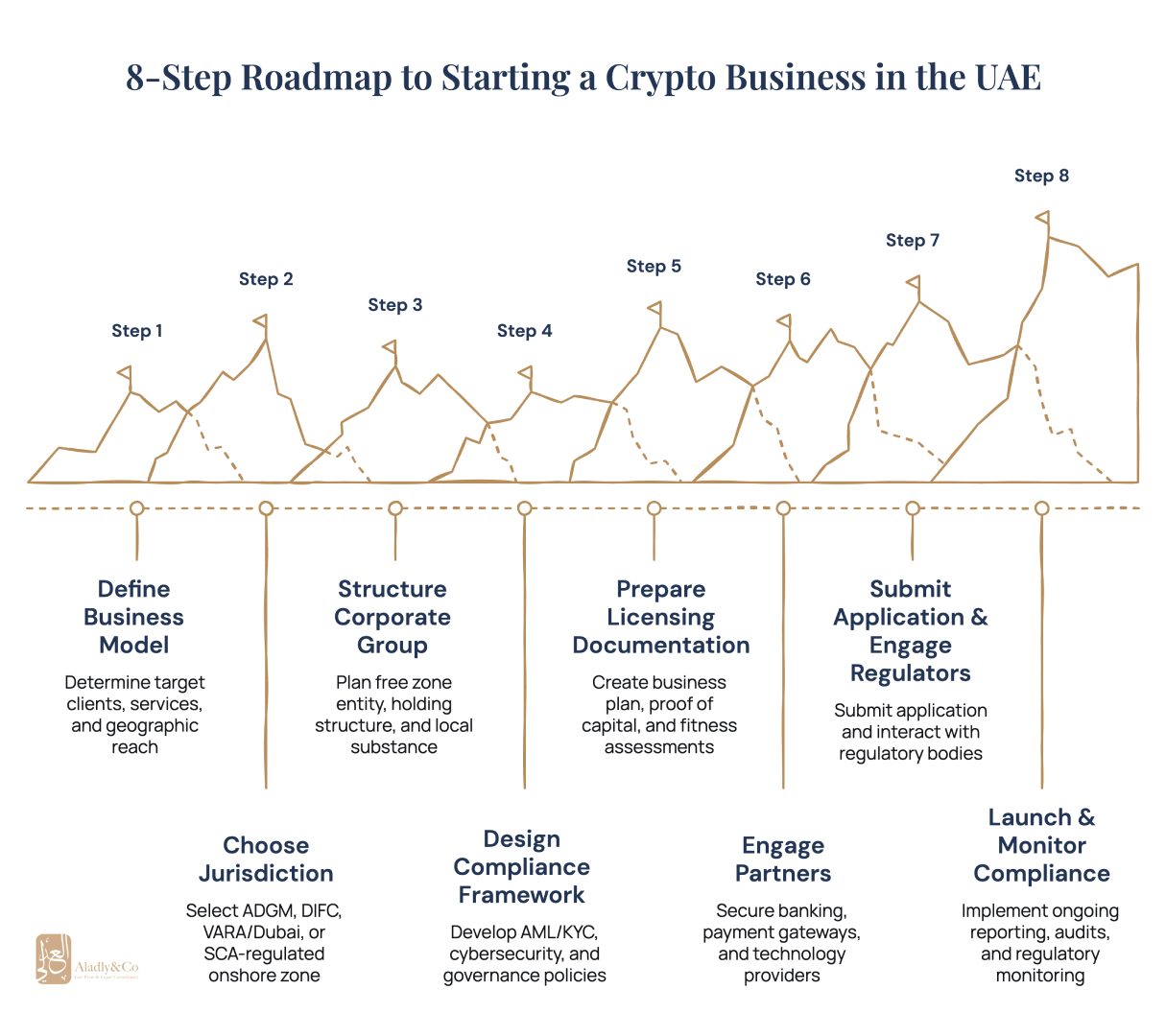
- Define Your Business Model:
Determine your target clients (retail vs. institutional), services, and geographic reach. - Choose the Optimal Jurisdiction:
Based on your client profile, decide between ADGM, DIFC, VARA/Dubai, or an SCA-regulated onshore zone. - Structure Your Corporate Group:
Plan your free zone entity, holding structure, and local substance requirements. - Design Your Compliance and Risk Framework:
Develop AML/KYC policies, cybersecurity measures, and clear governance. - Prepare Licensing Documentation:
Create a detailed business plan, proof of capital, and fitness and propriety assessments for management. - Engage Partners:
Secure banking relationships, payment gateways, and technology providers. - Submit Your Application and Engage with Regulators:
This process often takes several months. - Launch Operations and Monitor Compliance:
Implement ongoing reporting, audits, and monitor regulatory changes.
Each of these steps requires a well-thought-out regulatory strategy — not just ticking boxes on a checklist. Strategic legal counsel accelerates your time-to-market and reduces the risk of rejection.
Book a consultation with our experienced Blockchain Lawyers in Dubai to receive a tailored licensing roadmap and jurisdiction comparison for your project.
FAQ: Is Cryptocurrency Legal in the UAE?
No. A ruling by the Dubai Court of Cassation in November 2024 confirmed that personal trading does not require a license.
Not for individuals. Businesses, however, pay 9% corporate tax on profits exceeding AED 375,000.
Yes, if approved by the CBUAE. Only dirham-backed stablecoins are permitted for mass payments. Algorithmic and privacy-focused stablecoins are prohibited.
Ahmed Adly
Founder & Managing Partner
Ahmed Adly is the founder and managing partner of Al Adly & Co, advising international businesses and entrepreneurs operating in the UAE and Egypt. With more than 20 years of legal experience and a background in senior government legal roles, he helps clients navigate regulatory complexity, structure transactions, and resolve high-value disputes.
Disclaimer: This content is for general informational purposes only and does not constitute legal advice. Cryptocurrency laws and regulations in the UAE change frequently. Readers should seek tailored advice before making any decisions.